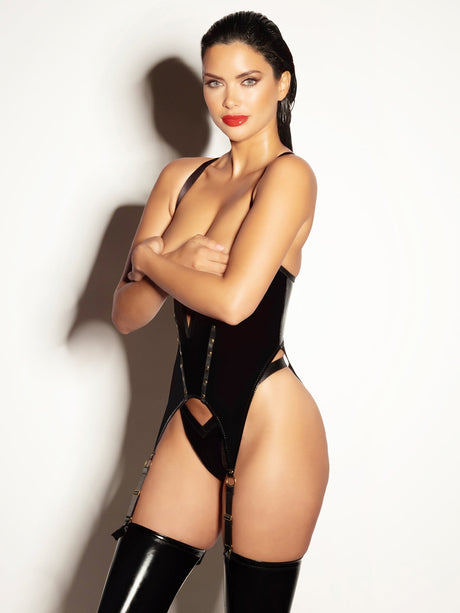
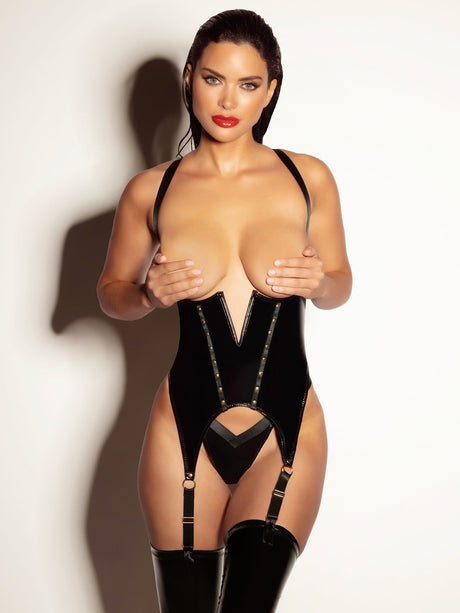
What is a demi bra?
Demi is French for half, and that is close to literal: the cups cover roughly half to three quarters of the breast. But the definition people actually need is not the amount of coverage, it is the angle of the top edge. A demi cup is cut on a diagonal that slopes downward toward the centre of the body. A balconette cup, which covers a similar amount, runs horizontally straight across. That one difference is why the two look distinct under clothing despite covering almost the same area, and it is the thing every glossary definition leaves out. The second structural feature: demi straps sit wider apart and attach further out on the cup, which is what makes them work under scooped and square necklines where a full-coverage strap would show. Coverage is not support, though. A demi holds you through the band exactly as any bra does, so the lower cup edge is a styling decision rather than a support one — with one real consequence, which is less containment when you move.
Demi and balconette get used as if they were the same word, and they are not.
One cup edge runs straight across. The other slopes. Everything else follows from that.
- Demi edge slopes; balconette edge runs straight. Same coverage, different line.
- Straps sit wider and attach further out on the cup.
- Coverage is not support. The band holds you either way.
- Less upper containment means more movement. Not a sports option.
- Gaping at the top is usually a moulded cup meeting a shallower shape.
- Works under scoop, square, boat and off-shoulder necklines.
- Above a DD, look for seamed cups and a wide side support panel.
The Cup Edge Is the Definition
Bra styles are usually explained by how much they cover. More useful is where the top edge sits and what angle it runs at, because that is what you see and what determines which necklines work.

A full-coverage cup finishes at or near the top of the breast. A balconette finishes around the halfway mark with a horizontal edge. A demi finishes around the same height but on a slope. A shelf or quarter cup supports from below with minimal upper coverage.
Two things follow from a lower edge, and they pull in opposite directions.
In its favour: no top-edge pressure. A lot of people find full-coverage cups cut or press across the upper breast, particularly if their shape is shallower at the top. A demi removes that entirely, which is why it is many people's most comfortable everyday shape.
Against it: less containment. There is simply less fabric above the breast to limit movement, which matters when you are active and does not matter at all when you are sitting at a desk.
Demi Versus Balconette

| Demi | Balconette | |
|---|---|---|
| Top edge | Angled down toward centre | Horizontal, straight across |
| Coverage | Half to three quarters | Roughly half |
| Shape created | Rounded, softer | Squared, lifted |
| Straps | Wide set, outer attachment | Wide set, often very wide |
| Best under | Scoop, sweetheart, wrap | Square, boat, straight necklines |
Because they cover similar amounts, brands use the words loosely and demi balconette exists as a hybrid label meaning roughly halfway between. Treat any of these terms as an indication rather than a specification, and judge the cup edge in the product photograph.
If the squared, level line is what you are after, our guide to balconette bras covers that style specifically.
Demi and Half-Cup Bras
Padded and unpadded, moulded and seamed, with the band and side construction that makes a lower cup edge work.
Shop Demi BrasBalconette BrasDemi Versus Full Coverage
This is the comparison most people are actually making, and the honest answer is that it is a coverage decision rather than a support one.
Support comes from the band in both styles. Roughly eighty percent of the load is carried around your ribcage regardless of how high the cup finishes. So a well-fitted demi and a well-fitted full-coverage bra in the same size support comparably while you are standing still.
What differs is containment during movement. More fabric above the breast limits motion. That is why full coverage suits high-impact activity and why demi does not, and it is the one genuine functional difference between them.
| Choose | When |
|---|---|
| Full coverage | High necklines, active days, maximum containment, minimal movement |
| Demi | Wide or scooped necklines, top-edge discomfort, everyday wear |
| Balconette | Square and straight necklines, a level lifted line |
| Plunge | Deep V necklines, where the centre must stay hidden |
Why the Straps Sit Wider

Demi straps attach toward the outer edge of the cup rather than near the centre, which sets them wider on the shoulder. That is a deliberate design choice with a clear purpose: it keeps them outside the line of a scooped or square neckline.
The trade is that wider-set straps are slightly more prone to slipping, particularly on narrow or sloped shoulders. Two practical responses: look for a convertible demi, which can be reconfigured to crossback, or adjust the straps more frequently than you would on a centrally set style. It is also worth remembering that straps should only ever carry a minority of the weight, so slipping straps often point at a loose band rather than a strap problem.
Demi Bras Above a DD
The received wisdom is that demi styles suit smaller busts. As with plunge bras, that is a construction limitation being reported as a rule.
Less upper containment does matter more as volume increases, so a flimsy demi genuinely will not work above a D. But a demi built properly is a different object. Four things to look for:
- Seamed cups rather than moulded. Above a DD a pressed shape gapes at the top on most people, and a demi puts that edge right where it shows.
- A wide side support panel, ideally with an angled seam, to keep volume forward rather than migrating toward the underarm.
- A firm, taller band with three or four hook rows. The band is doing the support work; the cup edge only decides coverage.
- Full-length wires following your root all the way to the underarm rather than stopping short.
The reasoning is the same as in our plunge bra guide: when a style removes coverage or an anchor point, the band and sides absorb the difference, and the quality of those components decides the size ceiling.
What to Wear It Under
| Neckline | Demi works? | Note |
|---|---|---|
| Scoop neck | Yes, ideal | Cup edge and straps both stay hidden. |
| Square neck | Yes | Balconette is squarer still if you want a level line. |
| Sweetheart | Yes, ideal | The angled edge follows the neckline shape. |
| Boat neck | Yes | Wide straps sit clear. |
| Off shoulder | With a convertible | Or a strapless demi. |
| Deep V | No | A plunge keeps the centre hidden. |
| High crew | Works, but pointless | Nothing shows either way, so choose for comfort. |
Five Fit Checks
- The band sits level all the way round and fastens on the loosest hook when new. Riding up at the back means it is too large.
- The gore touches your sternum. A gap means the cup is too small, in a demi as in anything else.
- Scoop, then look at the top edge. It should lie flat against you. Gaping means the cup shape does not match yours; cutting means the cup is too small.
- Check the underarm. Tissue escaping toward the armpit means the side panel is not doing enough, which is a construction issue rather than a size one.
- Slip the straps off. If everything drops, the band is too loose and the straps have been compensating, which is also why they were slipping.
Gaping at the top edge of a demi is the single most common complaint, and the usual response is to size down the cup, which makes everything else worse. The real cause is almost always a moulded cup holding one pressed profile that assumes a fuller upper breast than you have. Nothing is wrong with your shape; the cup was built for a different one. A seamed cup, or a demi with a stretch lace upper edge, conforms to you instead of the reverse.
Nobody needs to know the French etymology. They need to know that one edge slopes and the other does not, because that is what they will see in the mirror.
HauteFlair Fit Team
What This Means for You
A demi covers roughly half the breast with a top edge angled down toward the centre. A balconette covers a similar amount with a straight horizontal edge. That angle is the whole difference, and it decides the line you get under clothing.
Coverage is not support. The band carries the weight in every style, so choosing a demi is a decision about necklines and comfort rather than about how well you will be held. The one real trade is containment during movement.
Above a DD, look for seamed cups, a wide angled side panel, a firm band and full-length wires. And if the top edge gapes, change the cup construction rather than the size.
Demi Bras at HauteFlair
Demi and half-cup styles, padded and unpadded, seamed and moulded, across bands 28 to 48 and cups A to K.
Shop Demi BrasFind Your SizeFrequently Asked Questions
What is a demi bra?
What is the difference between a demi bra and a balconette?
Is a demi bra the same as a half cup bra?
Can you wear a demi bra with a large bust?
What tops work with a demi bra?
Why does my demi bra gape at the top?
Does a demi bra give lift?
Is a demi bra comfortable for everyday wear?
What is a demi balconette?
Demi bra versus full coverage: which should I choose?
How should a demi bra fit?
Can a demi bra be strapless or convertible?
This article is for informational purposes only. Style terminology is not standardised between manufacturers, so cup measurements and product photographs are more reliable than category labels. Fit guidance is general; always check the size chart on the individual product.