Why does my bra ride up at the back?
A bra rides up at the back because the band is too loose, not because the straps need tightening. The band carries roughly 80 percent of a bra's support, so a band that does not grip the ribcage hands that load to the straps, and the straps pull the back of the band upward. The fix is almost always a smaller band with a larger cup, known as the sister size. A 36C becomes a 34D. Tightening the straps makes a riding band worse, not better.
That is the wrong lever, and it is the reason the problem never goes away. Riding bands and slipping straps are two symptoms of one fault, and the fault is almost always in the band. This guide gives you a five-check diagnostic, the sister-size fix with a real table, and an honest account of the handful of cases where the band genuinely is not to blame.
- The band carries roughly 80 percent of the support. The straps only steady the cups, so a band that does not grip hands that load upward.
- Tightening the straps makes a riding band worse. Strap tension pulls the back band up, which is the exact motion you are trying to stop.
- Slipping straps and a riding band share one cause. Straps carrying weight they were not designed for dig in, stretch, then slip.
- The fix is a sister size: down one band, up one cup. 36C becomes 34D, 38B becomes 36C, 36D becomes 34DD, 38H becomes 36HH.
- A new bra should fit on the loosest hook. If it only fits on the tightest hook in the fitting room, it has no life left in it.
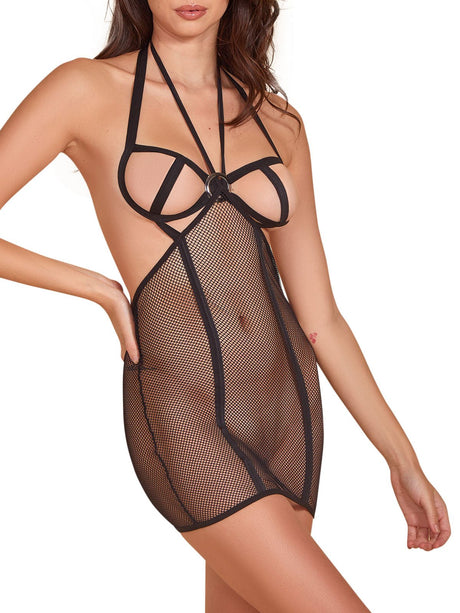
- Racerback and front-closure styles help, but our range is small. HauteFlair stocks 8 racerback and 10 front-closure styles against 555 bras overall.

It is the band, and it is almost never the straps
A bra that rides up at the back has a band that is too big for the ribcage it sits on. That is the diagnosis in nearly every case, and the straps are almost never the cause. A band that grips cannot travel upward, because friction and tension hold it in place. A band that does not grip is free to move, and the only force acting on it is the pull of the straps over the shoulders. So it goes where the straps take it, which is up.
Here is the loop that keeps people stuck. The band rides up, the bra feels unsupportive, so the wearer tightens the straps. Tighter straps pull the back band higher still. Within a few weeks the straps are at their shortest setting and the band is sitting near the shoulder blades doing nothing at all.
Tightening the straps is the most common response to a riding band and it is the one action that reliably makes it worse. Straps pull upward on the back of the band. If your straps have been tightened more than once in the last month, loosen them, and change the band instead.
The band does about 80 percent of the work
A bra band provides roughly 80 percent of a bra's support and the straps provide the remaining 20 percent. The band is a closed loop of elastic under tension around the ribcage: it anchors the garment and resists downward force from the cups. The straps have a narrower job. They steady the cups and stop the top edge gaping. They are stabilizers, not load-bearers.
When the band loosens, that ratio does not rebalance politely. The load has to go somewhere, and the only other attachment point is the shoulders. Two narrow strips of elastic then carry weight a full band of powernet was engineered to hold. They stretch faster, cut into the trapezius, and wander off the slope of the shoulder.
If you can pull the back of your band more than two fingers away from your body, the band is not supporting you. Everything else you are feeling is a downstream symptom of that one measurement.
HauteFlair Editorial
Diagnose it in five checks
Five checks will tell you whether your band is the problem, and they take about three minutes in front of a mirror. Do them wearing the bra you are complaining about, with the cups scooped and settled.
Is the band level from front to back?
Stand side-on to a mirror and look at the line the band makes around your body. A correctly fitted band sits level, or a fraction lower at the back than at the front. If the back of the band sits higher than the underwire at the front, the band is too loose. This is the definitive visual, and it needs no tape measure.
Which hook are you wearing it on?
Look at which row of hooks you have fastened. If you are on the tightest row, you have run out of adjustment and the band is either too big or worn out. If it still rides on that row, the band is too big and no amount of care will rescue it.
Can you pull the band more than two fingers off your back?
Hook two fingers under the back of the band and pull straight out. Two fingers of give is the ceiling for a correctly fitted band. If your whole hand slides under, the band is at least one size too big. If you cannot fit one finger, the band is too tight and you should go up rather than down. Stand upright for this one.
Does it ride up when you raise your arms?
Raise both arms straight above your head, lower them, and look in the mirror. A correctly fitted band stays put or moves less than about half an inch. A loose band travels up with your arms and stays there. This test catches bands that pass the standing check but fail in real life.
How often do you tighten the straps?
Count how many times you have shortened the straps in the last month. Straps on a well-fitting bra need adjusting when you buy it and then rarely, perhaps every few months. If you are tightening them more often than every couple of weeks, they are compensating for a band that is not holding.
Before you judge any of these checks, lean forward, reach into each cup and sweep the breast tissue forward and up into the cup. A badly seated cup mimics several band faults. Our bra fitting guide walks through the full seating routine.
The fix: down one band, up one cup
If your band is too loose, go down one band size and up one cup size. That combination is called a sister size, and it keeps cup volume roughly the same while tightening the band. Cup letters are not absolute volumes: a C cup on a 36 band holds more than a C cup on a 34 band, so dropping the band without raising the letter would shrink the cup and hand you a fresh problem, spillage. If you are unsure of your starting size, work through how to measure your bra size first. The full ladder lives in our sister sizes guide.
| You wear now | Band feels | Sister size to try | Cup volume | In stock |
|---|---|---|---|---|
| 34C | Loose, rides up | 32D | Same | 114 styles |
| 36C | Loose, rides up | 34D | Same | 128 styles |
| 38B | Loose, rides up | 36C | Same | 108 styles |
| 40C | Loose, rides up | 38D | Same | 112 styles |
| 36D | Loose, rides up | 34DD | Same | 47 styles |
| 38H | Loose, rides up | 36HH | Same | 20 styles |
| Any size, band too tight | Digging, cannot breathe | Up a band, down a cup | Same | Reverse the table |
Two honest caveats. Choice thins as you climb the cup letters: we carry 128 styles in 34D but 20 in 36HH, so a sister-size move at the top of the range means a shorter list, not an equal swap. And a sister size is a starting point. Cup shape, wire width and band stretch vary by brand, so treat the new size as the first one you try on rather than the answer.
A new bra should fit on the loosest hook
A new bra should fit correctly on the loosest row of hooks. That is the rule, and it is the one most people get backwards. The hooks are not a comfort dial, they are a stretch allowance. Band elastic relaxes with wear and washing, so the tighter rows give back the tension you lose over the life of the bra.
Buying a bra that only feels supportive on the tightest hook means buying a bra already at the end of its useful life. Within a couple of months that band will have relaxed past the point of holding, and you are back to a riding band with no adjustment left. If the loosest hook feels loose but the tightest feels right, the band is one size too big.
Trying on a new bra: fasten it on the loosest hook first, every time. If it needs the middle or tightest row to feel secure on day one, put it back and try the band size below with one cup size up.
Why your straps keep falling is the same problem
Straps that keep falling off your shoulders are usually reporting the same band fault from the other end. Once the band stops holding, the straps carry weight they were never engineered for. Under that load the elastic stretches, the shoulder end migrates outward toward the point of the shoulder, and gravity does the rest. You tighten it, which digs a groove without solving anything, and pulls the band up another notch.
The order matters, because it explains a symptom that feels random. Loaded straps dig in first, then slip. If your straps leave red marks and fall down, that pairing is close to diagnostic: it means load, not length. Straps that slip without ever digging in point to shoulder slope or strap placement, covered below.
| What you notice | Band or straps? | First thing to change |
|---|---|---|
| Back of band sits higher than the front underwire | Band | Down a band, up a cup |
| Straps dig in and leave marks, and also slip off | Band | Down a band, then loosen the straps |
| Band rides only on the tightest hook | Band | Down a band, or replace a worn bra |
| Straps slip but never dig in, band sits level | Straps | Racerback clip or a closer-set strap style |
| Band rides up and the bra is over a year old | Both | Replace it, then fit the new one on the loosest hook |
| Cups gape at the top, band sits level | Neither | Cup shape or size, not band tension |
When it genuinely is not the band
A minority of riding bands and slipping straps are not size problems. These four causes account for most of the rest. Rule out the band first with the five checks, then look here.
Band elastic fatigues with heat, agitation and time. A bra worn twice a week and machine washed hot loses meaningful grip inside a year. Hand wash or use a mesh bag on cold, hang to dry, never tumble dry, and rotate at least three bras so each rests a day between wears.
Sharply sloping shoulders give a strap nothing to sit against, so it slides outward regardless of tension. This is anatomy, not a fit fault. Racerback styles, a converter clip, or halter and cross-back designs move the anchor inboard where the slope is shallower.
Some bras set straps too wide for a narrow frame, so they sit near the shoulder points and slip immediately. Look for balconette and plunge shapes with anchors set close to the cup center, or full figure styles, which place straps closer to the neck by design.
If only one strap slips, the cause is usually asymmetry rather than sizing. Most people have one shoulder lower than the other and one breast slightly larger. Fit the band and cup to the larger side, then shorten the strap on the slipping side alone.
Style fixes that actually work, and our honest range
Three construction changes reliably reduce riding and slipping: a racerback strap layout, a front closure, and a wider band. Each addresses a different part of the problem, and each has a trade-off worth knowing before you buy.
Body shape factors that change the answer
Four body-shape factors make a riding band more likely, and none of them are faults. They change which band construction suits you rather than which size you take.
A short torso
A short torso leaves less vertical space between underbust and waist, so a band has less room before it climbs over the ribs. Choose a narrower band depth rather than a longline. Longline styles ride on short torsos for a mechanical reason: the band edge meets the waist crease and gets pushed upward every time you sit.
A high or conical ribcage
A ribcage that tapers upward sharply gives a band a slope to slide up. The band needs to be genuinely snug to resist that geometry, and a wider band helps. If bands have always ridden on you no matter the size, check this before assuming you are between sizes.
One shoulder lower than the other
One shoulder sitting lower than the other is very common and is the usual reason a single strap slips while the other behaves. Adjust each strap independently rather than matching them. If the difference also shows in cup fill, our guide to uneven breasts explains how to fit the larger side.
Fuller cups on a smaller frame
A fuller cup on a small band punishes a loose band hardest, because there is more weight and less band to hold it. Sizes like 32D, 34DD and above need a band tight enough that you notice it when you first fasten it. Read our guide to cup sizes if the letters are the confusing part, or breast shapes if the cup fits oddly at the top or sides.
A correctly fitted band feels snug and noticeable, not painful. Persistent numbness in the arms, deep welts that remain hours after removal, rib pain, or skin that breaks down under the band are not normal fit outcomes and are worth raising with a doctor or pharmacist rather than solving with a smaller size.
Frequently asked questions
Why does my bra ride up at the back?
Should I tighten my straps if my bra rides up?
What size should I try if my band is too loose?
Which hook should a new bra fit on?
How tight should a bra band actually be?
Why do my bra straps keep falling down?
My straps dig in and slip off at the same time. What does that mean?
Only one strap slips. Why?
Do racerback bras stop straps falling down?
Will a front-closure bra fix a riding band?
How do I know if my bra is worn out rather than the wrong size?
Does a wider band stop a bra riding up?
Can a short torso cause a bra to ride up?
Is it normal for a correctly fitted band to feel tight?
This guidance is general and not a substitute for a professional fitting or medical advice. Bra sizing varies between brands and between styles from the same brand, so always check the size chart on the product page before ordering. Persistent pain, numbness or skin irritation under a band or strap is worth discussing with a doctor or pharmacist.