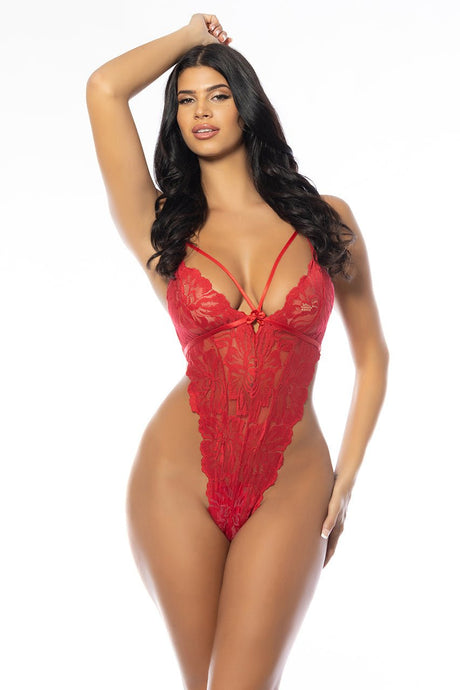
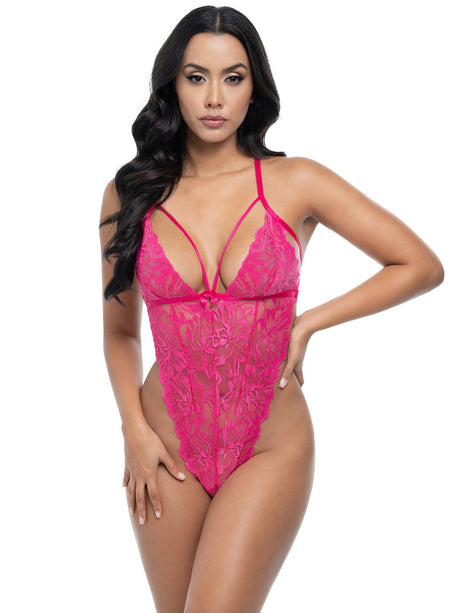
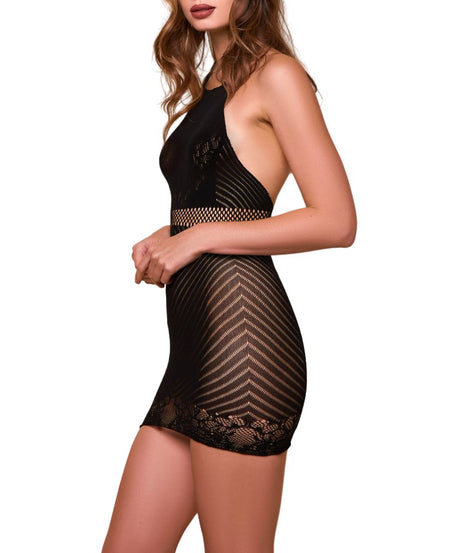
What is a halter dress?
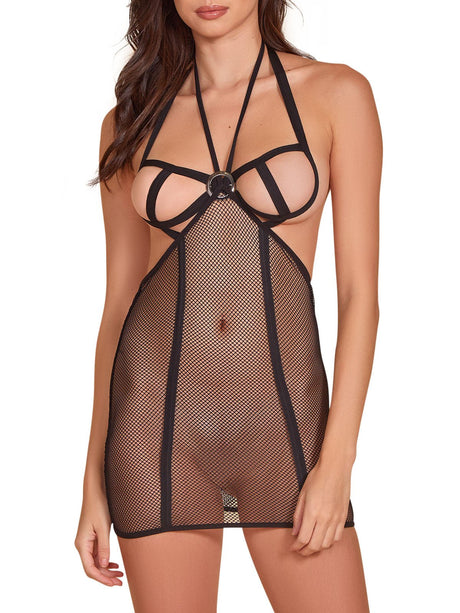
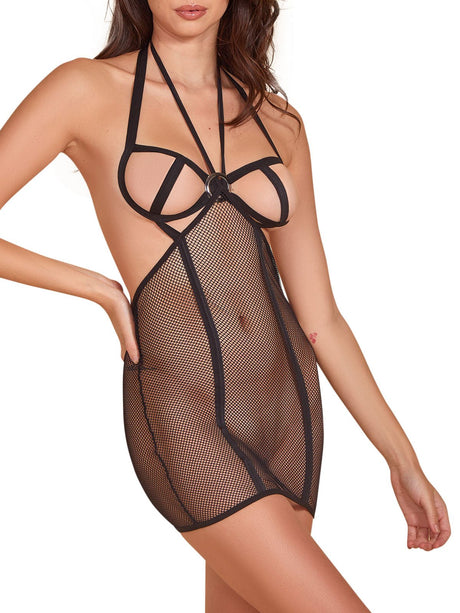
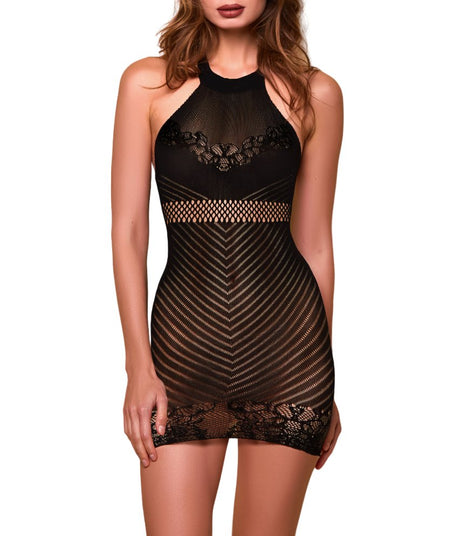
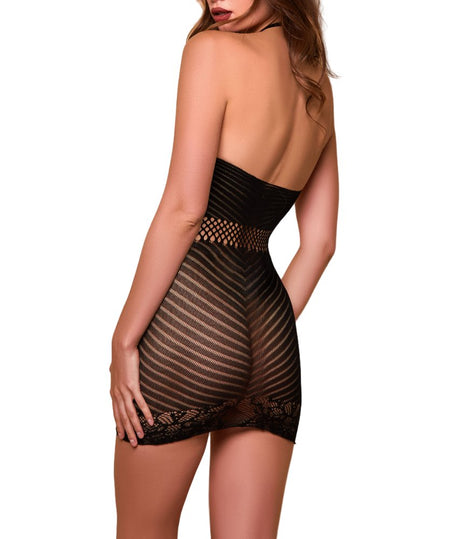
A halter dress is a dress held up by a strap that goes around the back of the neck instead of over the shoulders. The shoulders and upper arms are bare, and the back is often partly or fully open.
Halter describes the neckline and how the bodice is supported, not the length or the silhouette. A halter dress can be a mini, a midi or a floor-length gown, fitted or flowing, casual cotton or evening satin.
Two things decide whether one works for you. The first is how the neck strap carries the bodice, which governs comfort and support. The second is how far down the back is cut, which decides what, if anything, can be worn underneath. The neckline gets the attention, but the back is usually the deciding detail.
The halter is one of the few necklines that changes how a dress is engineered, not only how it looks.
Once the shoulders stop carrying the bodice, the neck does, and almost every question about fit, comfort and what to wear underneath follows from that.
- A halter hangs from the neck, not the shoulders. Shoulders and arms are bare.
- Six halter necklines cover almost every version: tie, band, high neck, V, crossover and keyhole.
- Strap width decides comfort. A thin tie concentrates the weight at one point on the neck.
- The armhole decides side coverage. Cut-in armholes show more of the side of the chest.
- The back decides the bra. Covered to band level, a convertible bra works. Lower, it will not.
- Style the neckline, not around it: hair up, earrings over necklaces, open-front layers.
What Makes a Dress a Halter
A halter is defined by where the support goes: up and around the neck. Everything else is variation.
On a conventional dress, shoulder straps or sleeves run over the top of each shoulder and the back of the bodice anchors the front. On a halter, the straps angle inward from the bodice and meet behind the neck. The shoulders are left completely bare, and because the straps no longer need the back for anchoring, designers often open the back as well.
The name comes from the halter used on horses, a strap that goes around the head and neck. In fashion the neckline became prominent in 1930s evening wear, returned through mid-century sundresses and swimwear, and has cycled back regularly since. It now appears at every price point, from cotton day dresses to bias-cut satin gowns.
It is worth separating the halter from three necklines it is often confused with:
- Racerback: straps go over the shoulders and converge between the shoulder blades. The shoulders still carry the weight.
- One-shoulder: a single strap or sleeve crosses one shoulder diagonally. One shoulder carries the load.
- Strapless: nothing goes over or around the shoulders. The bodice holds itself up around the ribcage.
The Six Halter Necklines
These six account for nearly every halter dress. Each one changes coverage, support and what fits underneath.
| Neckline | What it looks like | Best for | Under it |
|---|---|---|---|
| Tie halter | Two straps rise from the bodice and tie at the nape | Casual and vacation dresses; adjustable fit | Depends on the back; the tie lets you set the height |
| Band or collar halter | A continuous band circles the neck, closing with a hook or button | Evening and cocktail; spreads the load across a wider band | Often has a covered back; convertible bras |
| High-neck halter | Covers the chest to the base of the throat with cut-in armholes | Modern, sporty looks; more front coverage | Narrow-set cups; watch the side exposure |
| V or plunge halter | A deep V to the sternum with straps running from the cup edges to the neck | Evening gowns, statement dresses | Plunge bras, tape or adhesive |
| Crossover halter | Fabric panels cross at the front before wrapping the neck | Jersey and draped dresses; flattering ruching at the bust | Low-gore or seamless options |
| Keyhole halter | A high halter with an opening cut into the center front | Evening and cocktail; coverage with a focal point | Check the opening depth against your bra center |
Straight versus cut-in armholes
The armhole is the detail most people miss. A straight armhole drops roughly vertically from the neck strap to the side seam and covers the side of the chest. A cut-in armhole curves inward toward the neck, showing the full shoulder and more of the side. Cut-in armholes look sharper and more athletic but give less side coverage and make a conventional bra harder to hide. If side coverage matters to you, check product photographs taken from the side before you buy.
Each Halter Neckline in Detail
The summary table above sorts the six. This section covers how each one wears, who it suits and what to check before buying.
Tie halter
The tie halter is the most common and the most adjustable. Two straps rise from the top of the bodice and tie at the back of the neck, so you can raise or lower the neckline by retying. That adjustability is its main advantage: a tie halter fits a wider range of torso lengths than any fixed strap.
The trade is comfort. All of the tension meets at one knot, and a knot sitting on the vertebrae at the base of the neck becomes noticeable within an hour or two, especially in a heavier fabric. Tie halters suit light cottons, linens and jersey, and they are the natural choice for vacation and daytime dresses. For a long evening, a wider tie or a flat knot tied slightly to one side helps.
Band or collar halter
A continuous band circles the neck and closes with a hook, button or snap. Because the band is wider than a tie and has no knot, it spreads the load evenly and is usually the most comfortable halter for a fuller bust or a heavy fabric. It also reads more formal, which is why it appears so often on cocktail dresses and evening gowns.
Check two things. First, the band should sit flat without pressing into the front of the throat; a band cut too small will ride forward. Second, a fixed band cannot be adjusted, so the drop from neck to bust must suit your torso. If the bodice sits too low, the band can be shortened by a tailor; if it sits too high, there is often too little fabric to lengthen it.
High-neck halter
The high-neck halter covers the chest up to the base of the throat and leaves the shoulders bare through cut-in armholes. It is the most modern-looking version, with a clean, sporty line that works in rib knit, crepe and structured cotton.
It offers more front coverage than any other halter but less side coverage, because the armhole curves inward toward the neck. That makes it the hardest halter to wear a conventional bra under, since the side of the band and the outer cup edge often show. Look for designs with a built-in shelf or molded lining, or plan on adhesive options.
V or plunge halter
Straps run from the outer edges of the bodice to the neck, creating a V that can drop to the sternum or lower. It is the most dramatic halter and the one most associated with evening gowns and red-carpet dressing. It lengthens the neck and torso visually and suits most frames.
Support is the question. A deep plunge has no center gore holding the two sides together, so the bodice relies on the straps, the under-bust band and any internal structure. On a fuller bust, look for boning, sewn-in cups or a stabilized under-bust seam. Fashion tape along the inner edges keeps the V in place when you move.
Crossover halter
Fabric panels cross over the bust before wrapping around the neck, often with gathering or ruching at the center. The crossover is forgiving: the gathered fabric adds shape to a smaller bust and adjusts over a larger one, and the diagonal lines are flattering on most figures.
It is usually made in jersey or other stretch knits, so the fabric does much of the work. That makes it comfortable but less structured, and the crossing panels can shift apart if the knit is thin or the under-bust band is loose. Check that the panels stay crossed when you raise your arms.
Keyhole halter
A keyhole is a high halter with an opening cut into the center front, typically a teardrop or oval. It offers coverage with a focal point and suits cocktail and evening wear where a full plunge would be too much.
The detail to check is where the opening sits relative to the center of your bust. If the keyhole drops to the level of a bra's center gore, that gore will show. A small, high keyhole works with most options; a deep one behaves like a plunge.
A Short History of the Halter
The halter has moved between beachwear and evening wear for almost a century. Each revival has changed what the word calls to mind.
The neckline takes its name from the halter used on horses, a strap that loops around the head and neck. In fashion it rose to prominence in the 1930s, when bias-cut evening gowns in satin and crepe began to leave the back and shoulders bare. Designers such as Madeleine Vionnet cut dresses that hung from a strap at the neck and fell close to the body, and the look became shorthand for evening glamour.
After the war the halter moved to the beach and the backyard. Cotton halter sundresses and swimsuits suited a leisure wardrobe, and the neckline took on a relaxed, summery reputation it has never fully lost. The most famous halter of the period is the pleated white dress designed by William Travilla and worn in the 1955 film The Seven Year Itch, which fixed the image of the halter as both playful and glamorous.
In the 1970s, Halston made fluid jersey halter dresses a signature of the decade's nightlife. Soft, unstructured and easy to move in, they showed that a halter could hold without boning or heavy construction when the fabric and cut were right. The 1990s brought a minimal version in slip-like satin, and the silhouette has cycled back regularly since, now appearing at every price point from cotton day dresses to couture gowns.
That history explains why the halter can read so differently. In cotton it recalls midcentury summers; in jersey it recalls the disco era; in satin or crepe it recalls 1930s evening wear. The neckline is the same. The fabric and length decide which story it tells.
Halter Compared With Other Necklines
The useful comparison is not how each neckline looks but what carries the weight and what that leaves room for underneath.
| Neckline | What carries the bodice | Shoulders | Ease of wearing a bra |
|---|---|---|---|
| Halter | A strap around the neck | Bare | Depends on the back; convertible bras help |
| Racerback | Straps that meet between the shoulder blades | Partly covered | Racerback or convertible bras |
| Spaghetti strap | Thin straps over each shoulder | Mostly bare | Straps may show beside the dress straps |
| One-shoulder | One diagonal strap or sleeve | One bare | Convertible one-shoulder setting or strapless |
| Strapless | The bodice itself, around the ribcage | Bare | Strapless bra |
| High neck with sleeves | Shoulders and sleeves | Covered | Almost any bra |
Halter and strapless are the two necklines where the usual bra rules stop working, and for opposite reasons. A strapless dress takes away the straps; a halter reroutes them. That is why a convertible bra can often solve a halter but rarely a strapless dress, where the band must work alone.
How a Halter Dress Holds Up
Every halter makes the same trade: freedom at the shoulders in exchange for weight at the neck. Good construction spreads that weight out.
When the neck strap carries the bodice, the weight of the fabric and the bust hangs from a relatively small area at the back of the neck. The pressure is manageable when it is spread and uncomfortable when it is concentrated. A thin tie in a heavy fabric is the worst combination; a wide band collar in a light fabric is the easiest.
How the bodice is built
Beyond the strap, the bodice construction decides how well a halter holds its shape. Darts are small tapered folds sewn into the fabric to shape it around the bust; they are simple and clean but offer limited shaping. Princess seams run vertically over the bust and shape the fabric more precisely, which gives a closer fit on a fuller bust. Gathering and ruching bunch the fabric and let it adapt to different shapes, which is why they are common in crossover and jersey halters.
The lining matters as much as the shell. A self-lined bodice uses a second layer of the same fabric and adds opacity. A structured lining may include power mesh, light boning at the side seams or molded cups, turning the dress into its own bra. An unlined bodice is lightest and coolest but offers no support and shows more of what is underneath.
Closures and how you get in
Halters close in several ways, and the closure affects both fit and comfort. Ties adjust but concentrate pressure. Hook-and-eye and button closures sit flat and spread the load. Snaps are quick but can pop open under tension. Some halters have no neck closure at all and are pulled on over the head, which only works with stretch fabric.
The body of the dress usually closes with a back zip, a side zip or no zip in a stretch fabric. On an open-back halter, the zip is almost always at the side, and it should run smoothly without puckering the side seam. A side zip that bows outward is a sign the bodice is too small.
Fit Problems and What Causes Them
Most halter fit complaints trace back to one of five causes. Try the dress on and check each before you commit.
| What you notice | Likely cause | What to look for instead |
|---|---|---|
| Neck ache after an hour | Thin strap carrying a heavy bodice | Wider strap or band collar; a defined under-bust band |
| Gaping at the side of the bust | Armhole cut wider than your frame, or cups too small | A size down in the bodice, or a straight armhole |
| Front pulls forward when you lean | No anchor across the back | A back strap or closure at band level |
| Bodice rides up when you raise your arms | Under-bust band too loose or missing | A snug band or elastic under the bust |
| Tie knot digs in | All tension at one knot | A flat hook closure or a band collar |
In the fitting room, raise both arms, lean forward and sit down. A well-made halter stays flat at the side of the bust, keeps the front close to the body when you lean, and does not climb when you reach. If it only behaves while you stand still, it will not behave at an event.
Who a Halter Suits
The halter works on any body. The details worth adjusting are strap width, armhole and support.
The angled straps form a V that draws the eye toward the center and up to the neck. That is why halters are often recommended for broad or athletic shoulders: the inward angle visually narrows the upper body. For narrow or sloping shoulders, a wider strap or band collar adds visual width where a thin tie would disappear.
For a fuller bust, the priority is support rather than shape. Look for a band collar, a snug under-bust seam and built-in cups or a structured lining. For a smaller bust, nearly any halter works, including unlined jersey and deep V styles that would need more structure on a larger frame. For a long torso, a halter with a high waistline or a defined waist seam keeps proportions balanced.

Sizing a Halter Dress and Buying Online
Halter dresses fit differently from strapped dresses because the shoulders no longer anchor the size. Three measurements matter more than the label.
Once you have those numbers, use the brand's size chart rather than your usual size. If you fall between sizes, size for the bust in a woven fabric and for the underbust in a stretch fabric, since knits will expand to fit the bust but cannot tighten a loose band.
Petite, tall and plus sizes
For petite frames, tie halters are the easiest to adjust because the straps can be shortened by retying. Fixed band halters may sit too low, and the waist seam may land below the natural waist. For tall frames, check that a fixed strap is long enough and that the waist seam does not ride up to the ribs. For plus sizes, look for halters graded with wider straps and a structured under-bust band in the larger sizes, not simply scaled-up versions of a thin-strapped design. Our guide to plus size lingerie explains why grading matters for anything that carries weight.
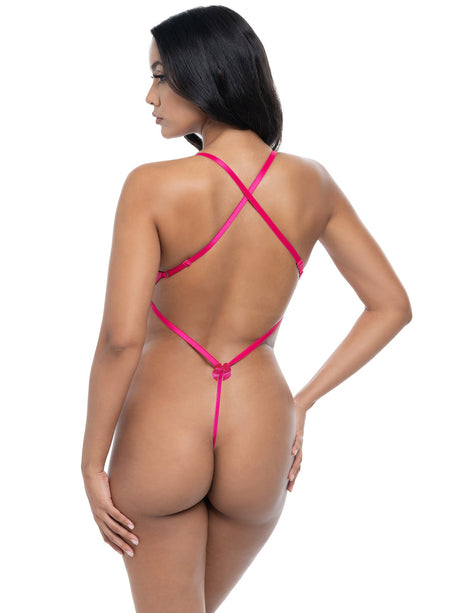
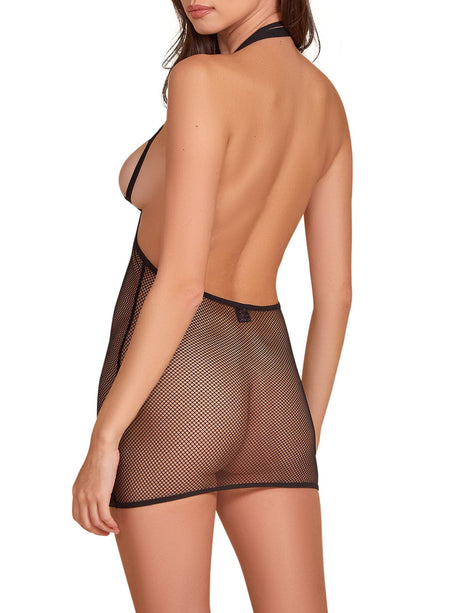
Look for three views before ordering: the front, the side and the back. The side view shows the armhole cut and how much side coverage you will have. The back view shows where the opening ends, which decides what can go underneath. If a listing shows only the front, ask for the others or assume the back is open.
Alterations: What a Tailor Can and Cannot Fix
Halters are more alterable than they look, within limits set by how much fabric the maker left.
| Problem | Usually fixable? | How |
|---|---|---|
| Neckline sits too low | Yes | Shorten the neck strap or band |
| Neckline sits too high | Sometimes | Only if there is spare strap length or seam allowance |
| Side gaping at the bust | Often | Take in the side seam or add a small dart |
| Neck strap uncomfortable | Yes | Replace a tie with a flat hook or button closure |
| Bodice swings forward | Yes | Add a thin strap or elastic across the back at band level |
| Not enough support | Yes | Sew in bra cups or add elastic to the under-bust seam |
| Armhole cut too deep | Rarely | There is usually no fabric to fill it |
| Too long | Yes | Hem, with care for bias-cut and chiffon |
Sewing cups into a dress is one of the most useful changes for a halter, because it removes the question of what to wear underneath entirely. Bring the bra style you would normally choose so the tailor can match the cup shape and placement.
Fabrics and What They Change
Fabric decides whether a halter reads as a beach dress or a gown, and how much of the layer underneath shows.
| Fabric | Best season | Formality | How much shows underneath |
|---|---|---|---|
| Cotton | Spring, summer | Casual | Little |
| Linen | Summer | Casual to smart casual | Little in darker colors; more in white |
| Jersey | All year | Casual to cocktail | A lot; edges print |
| Crepe | All year | Cocktail to black tie | Little |
| Satin | All year | Evening | The most of any fabric |
| Chiffon | Spring, summer | Wedding guest, evening | Depends on the lining |
| Velvet | Fall, winter | Evening, holiday | Little, but ridges show in the pile |

Color and print
Because a halter draws attention to the shoulders and neckline, the upper part of the dress carries the most visual weight. Solid colors keep the focus on the neckline shape, which suits band and keyhole halters where the cut is the point. Prints work best on tie and crossover halters in casual fabrics. A large print on a high-neck halter covers a lot of the chest in pattern, which can overwhelm a smaller frame. Pale colors in fine fabric show more of the layer underneath, so white and champagne halters need the most attention to what goes below.
Where to Wear a Halter Dress
The halter crosses from day to formal more easily than most necklines. Fabric and length make the change.
| Occasion | What works | Watch for |
|---|---|---|
| Day and vacation | Cotton or linen midi or maxi; tie halter | Sun on bare shoulders; tan lines from straps |
| Wedding guest | Crepe, chiffon or satin midi or maxi | Ceremonies that expect covered shoulders; bring a wrap |
| Cocktail and party | Band or keyhole halter in crepe or satin, knee to midi length | Check the dress code on the invitation |
| Black tie and gala | Floor-length halter column gown in crepe, satin or sequins | Structure for heavier fabrics |
| Work | High-neck halter under a tailored jacket, in relaxed offices | On its own it is usually too bare for most workplaces |
Halters and dress codes
| Dress code | Halter that fits | Length |
|---|---|---|
| Casual | Tie halter in cotton, linen or jersey | Mini to maxi |
| Smart casual | High-neck halter in crepe or structured cotton, with a jacket | Knee to midi |
| Cocktail | Band, keyhole or V halter in crepe or satin | Knee to midi |
| Semi-formal | Band or crossover halter in crepe, satin or chiffon | Midi to maxi |
| Black tie optional | Floor-length halter or an elegant midi in rich fabric | Midi to floor |
| Black tie | Floor-length halter gown in crepe, satin or embellished fabric | Floor |
For more on choosing a hem, our guide to mini, midi and maxi dress lengths covers where each length sits and which occasions it suits, and our midi dress guide covers where a midi hem should land. For specific invitations, our cocktail dress guide explains the cocktail dress code, and our wedding guest dress guide covers every wedding dress code.
How to Style a Halter Dress
The neckline is the focal point, so the styling job is to frame it rather than compete with it.
Jewelry by neckline
| Halter neckline | Earrings | Necklace |
|---|---|---|
| Tie | Hoops or small drops | A fine short chain can work |
| Band collar | Statement or long drops | None; the band is the necklace |
| High neck | Sculptural or drop earrings | None |
| V or plunge | Studs or small drops | A fine pendant inside the V |
| Crossover | Medium drops | Usually none |
| Keyhole | Drops | None; let the opening show |

Styling a halter through the seasons
Spring: a midi halter in cotton or crepe with a light trench or cropped jacket, flat sandals or block heels. Keep the jacket open so the neckline shows.
Summer: the halter's natural season. Linen and cotton maxis for vacation, tie halters for daytime, chiffon for weddings. Plan sun protection for bare shoulders, and consider how strap lines from swimwear will look above the neckline.
Fall: layer a fine long-sleeve top or thin turtleneck under a casual halter, add opaque tights and ankle boots. A crepe or velvet halter with a tailored blazer works for evenings.
Winter: reserve bare-shoulder halters for indoor evening events and holiday parties. Velvet, heavy crepe and sequins suit the season. Plan a coat that goes on and off easily over the neckline, and a wrap for arrival.
What to Wear Under a Halter Dress
Read the back of the dress first. Where it ends decides the options; the neckline only narrows them down.
Convertible, Adhesive and Plunge Bras
The three layers that cover nearly every halter back and neckline.
Convertible BrasAdhesive BrasPlunge BrasLook at the back of a halter before you look at the front. The neckline sells the dress; the back decides whether you can wear it the way you planned.
HauteFlair Editors
Caring for a Halter Dress
The neck strap is the part that wears out first, and the part most often damaged in storage.
Common Halter Mistakes
Most halter disappointments come from a small number of avoidable choices.
Halter Dress Buying Checklist
- Neckline: tie, band, high neck, V, crossover or keyhole, chosen for coverage and support.
- Back: where the opening ends, checked in a back photograph.
- Armhole: straight or cut in, checked in a side photograph.
- Support: under-bust band, lining, cups or boning.
- Strap: wide enough for the fabric weight, with a closure you find comfortable.
- Fabric: matched to the season, occasion and what you plan to wear underneath.
- Size: chosen from bust, underbust and neck-to-bust measurements, not the usual label.
- Underneath: planned before the event, based on the back.
What This Means for You
A halter dress hangs from the neck rather than the shoulders, which is what gives it bare shoulders, an often open back and a very particular set of fit questions. Choose the neckline for coverage and look, then check how the dress carries its weight: a wider strap, a snug under-bust band and built-in support make the difference between a dress you forget you are wearing and one you keep adjusting.
Let the fabric decide the occasion. Cotton and linen for day and vacation, crepe and chiffon for weddings, satin and sequins for evening. Style around the neckline with hair up, earrings over necklaces and open-front layers.
And before planning what goes underneath, look at the back. Covered to band level, a convertible bra in the halter setting will usually work. Any lower, and the answer is adhesive, tape or a dress with support built in.
Start With the Back of the Dress
Convertible bras for covered backs, adhesive options for open ones, and seamless pieces for fine fabrics.
Convertible BrasLow-Back Bra GuideSeamlessFrequently Asked Questions
What is a halter dress?
What bra do you wear with a halter dress?
Can you wear a halter dress with a big bust?
Why does my halter dress hurt my neck?
What is the difference between a halter and a high neck dress?
Are halter dresses appropriate for a wedding?
Who looks good in a halter dress?
How do you style a halter dress?
Can you wear a halter dress in winter?
What is a cut-in armhole on a halter dress?
What is the history of the halter dress?
How do I measure for a halter dress?
Can a tailor add support to a halter dress?
Should I wear a necklace with a halter dress?
How should I store a halter dress?
Is a halter dress good for petite women?
This guide covers dress construction, fit and styling and is for general information. Garment measurements and support vary between designers and between sizes within a range, so check the product details and size guide for any individual dress before ordering.