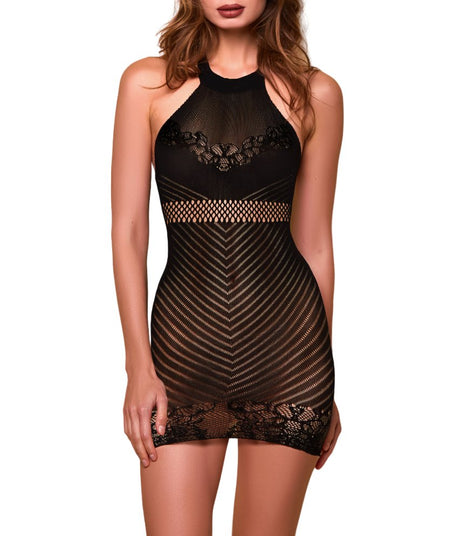
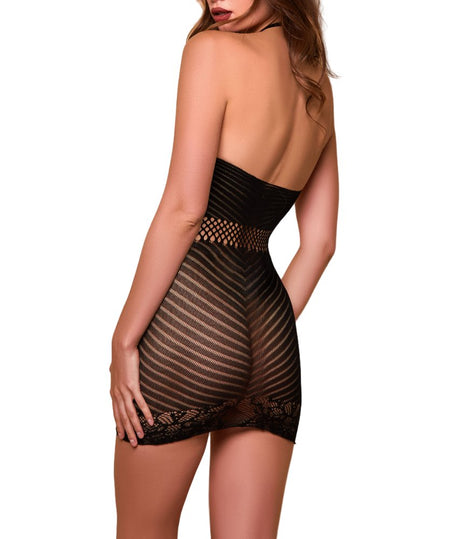
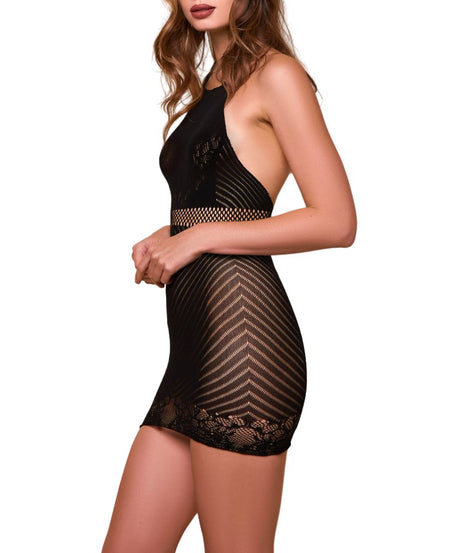
What is a backless dress?
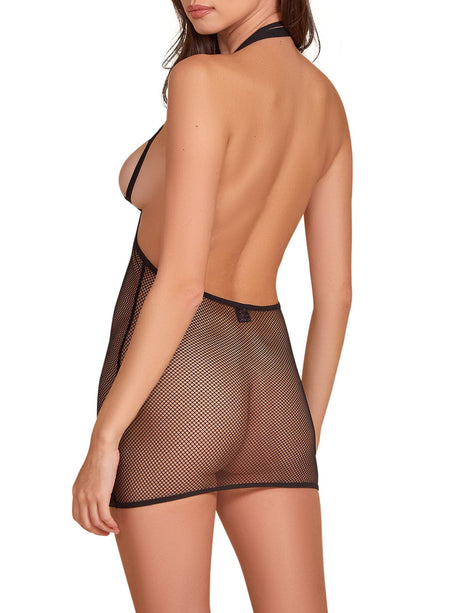
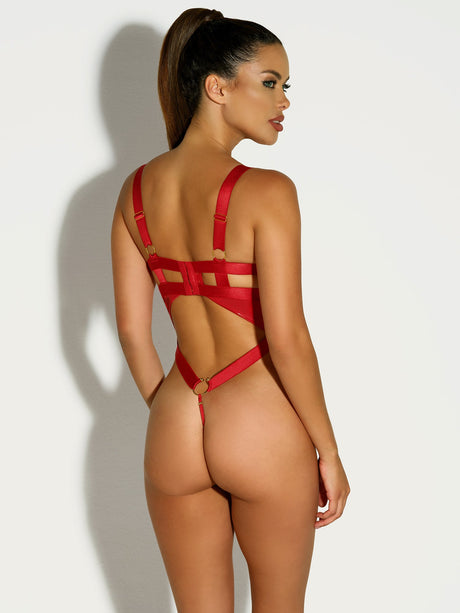
A backless dress is a dress with an open back, cut anywhere from a low scoop above the bra line to a drop that reaches the waist or below.
On most dresses, the back of the bodice anchors the front. Remove it, and the dress has to stay on some other way: a halter around the neck, a single shoulder strap, straps crossing the back, a structured strapless bodice, or a close fit through the sides.
Two measurements decide almost everything about wearing one: how deep the opening goes and what is holding the dress in place. Together they determine how secure it feels, which occasions it suits and what, if anything, can be worn underneath.
A backless dress looks effortless from across a room and is one of the most carefully engineered garments in a wardrobe.
Taking the back away removes the part that normally holds a dress on. How a design replaces it is what separates a dress that stays put from one you adjust all night.
- Backless, open back and low back overlap in retail. Low back usually means a shallower drop.
- Eight back styles cover nearly every design, from scoop to fully open.
- The depth of the opening sets what shows and what can go underneath.
- Something replaces the back as the anchor: a halter, one shoulder, crossing straps, a structured bodice or fitted sides.
- Gaping is the main fit problem. Bend, sit and reach before you buy.
- Heavy fabric pulls a low back open. The heavier the dress, the more structure it needs.
Backless, Open Back and Low Back
The three terms overlap, and retailers use them loosely. A working distinction helps when reading product descriptions.
Low back usually describes an opening that ends near the bra line or just below it, with fabric across the lower back. Open back often describes an opening framed by something: straps, a keyhole, a cutout or lacing. Backless usually means the back is bare to the waist or close to it. None of these is standardized, so the photograph of the back tells you more than the name does.
The Eight Back Styles
Each style ends at a different depth and stays on in a different way. Both matter more than the name.
| Back style | What it looks like | Typical depth | How it stays on |
|---|---|---|---|
| Scoop back | A rounded U-shaped opening | Upper to mid back | Shoulder straps; fabric below |
| V back | Straps or bodice edges meet in a point | Mid back to waist | Shoulder straps angled inward |
| Keyhole back | A closed neckline with an opening below it | Upper to mid back | Fastening at the neck |
| Cowl back | Fabric drapes in soft folds across the back | Mid back to waist | Weight of the drape; often bias cut |
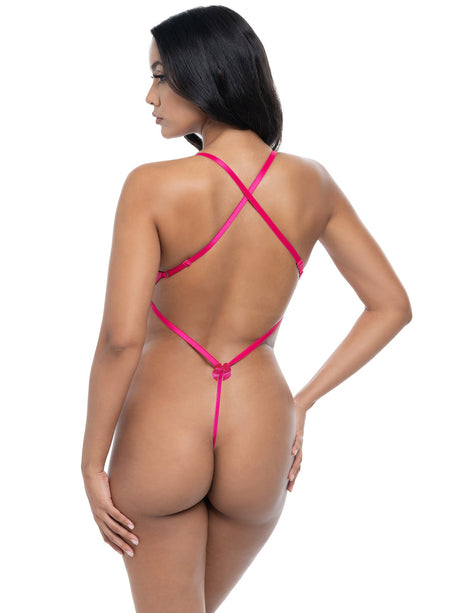
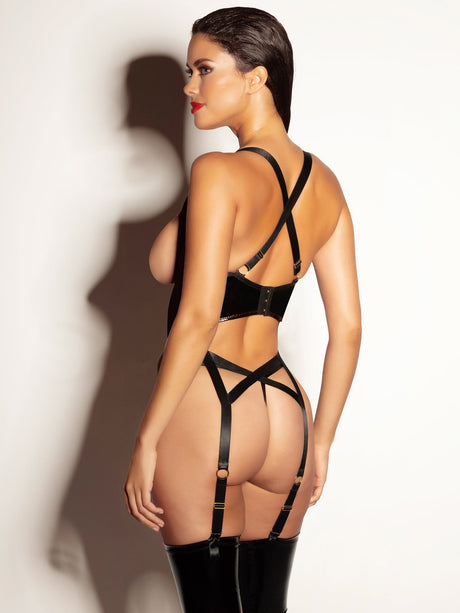
| Crisscross or strappy back | Straps cross the open back | Mid back to waist | Straps pull the sides toward the center |
| Lace-up back | Corset-style lacing across the opening | Mid back to waist | Lacing tension, often with boning |
| Cutout back | Shaped openings with fabric around them | Varies | The surrounding bodice |
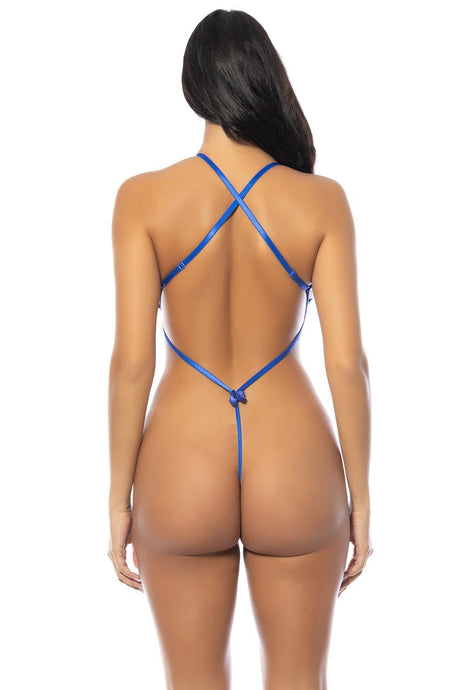
| Fully backless | The back is bare to the waist or below | Waist or lower | Halter, one shoulder or structured front |
Lace-up backs overlap with corset construction, which our guide to the corset dress covers in detail.

Each Back Style in Detail
The table above sorts the eight. This section covers how each wears and what to check before buying.
Scoop back
A rounded U-shaped opening, usually ending in the upper or mid back. The scoop is the gentlest backless style and the easiest to wear: shoulder straps anchor the dress, and fabric below the opening keeps the bodice close to the body. It suits day dresses, sundresses and understated evening wear. Check where the bottom of the U falls against your bra line; a shallow scoop often leaves room for a low-back bra.
V back
Straps or bodice edges angle inward to meet in a point. A V back draws the eye downward and reads more dramatic than a scoop at the same depth. The deeper the V, the more the straps have to pull inward to hold the sides flat, so look for straps that meet firmly at the point rather than floating apart. A V that ends at the waist behaves like a fully backless dress for everything underneath.
Keyhole back
A closed neckline with an opening below it, often teardrop or oval, and usually fastened at the nape with a button or hook. Because the neck and upper back stay closed, the dress is anchored securely and the opening is purely decorative. It is the most practical backless style for a fuller bust. Check that the fastening at the nape is strong; it is holding the whole back together.
Cowl back
Fabric drapes in soft folds across the back, usually in bias-cut satin, silk or jersey. The weight of the drape holds it in place, which is why cowls need fluid, fairly heavy fabric to work. A cowl in a stiff or light fabric will stand away from the body instead of falling into folds. Cowls look best when you are standing or moving and can open more than expected when you lean forward, so test that in the fitting room.
Crisscross or strappy back
Straps cross the open back, sometimes once, sometimes in a lattice. The straps do real structural work: they pull the side panels toward the center and keep the front of the dress close to the body. That makes crisscross backs among the most secure open designs. Check that the straps are adjustable or sit flat without cutting in, and note that the straps make a bra band very hard to hide.

Lace-up back
Corset-style lacing across the opening, often with boning along the edges. The lacing lets you adjust the fit, which makes lace-up backs forgiving between sizes. The trade is that someone else usually needs to tie them. Look for eyelets or loops that are reinforced, since they carry the tension of the whole bodice.
Cutout back
One or more shaped openings with fabric around them. Cutouts give an open effect while leaving most of the back to anchor the dress. Placement matters: a cutout that lands exactly where a bra band sits will show it, while one above or below may not.
Fully backless
The back is bare to the waist or below, and all of the support comes from the front and sides. This is the classic evening gown back and the most demanding to wear. It needs a secure anchor at the neck or shoulder, a snug fit through the ribs and waist, and usually built-in cups.
A Short History of the Backless Dress
The backless dress became a signature of evening dressing when designers realized the back could carry as much drama as the front.
Open backs appeared in evening wear in the 1920s, but the backless gown came into its own in the 1930s. Bias cutting, developed and refined by designers such as Madeleine Vionnet, let satin and crepe fall close to the body, and gowns began to drop at the back while staying high at the front. Hollywood adopted the look quickly. Stars such as Jean Harlow wore slinky bias-cut satin that made the bare back the focal point of a dress, and the style became shorthand for glamour.
The practical reason was as much about fashion as film. A high front kept a gown modest by the standards of the day, while the open back delivered the surprise. That balance of a covered front and a revealing back is still the basis of most evening backless designs.
The idea returned in every era that favored fluid fabrics. In 1972, a black dress by Guy Laroche, worn by Mireille Darc in the film Le Grand Blond avec une chaussure noire, became one of the most famous backless dresses ever made: completely covered at the front and open almost to the base of the spine. The minimalism of the 1990s brought bias-cut slip gowns with cowl and low backs back to the red carpet, and today open backs appear on everything from cotton sundresses to bridal and black-tie gowns.
Backless Compared With Other Open Designs
Several styles show skin at the back. What separates them is how much the back is still doing to hold the dress on.
| Design | What is open | Back still anchors the dress? | Bra difficulty |
|---|---|---|---|
| Fully backless | The whole back to the waist | No | Highest |
| Low back | Upper and mid back | Partly, from below | Moderate |
| Open back with straps | Back framed by straps | Partly, through the straps | Moderate to high |
| Keyhole back | An opening below a closed neckline | Yes | Low if the keyhole is small |
| Cutout | Shaped openings | Mostly | Depends on placement |
| Halter | Shoulders, often the back | No; the neck does | Depends on the back |
Opening Depth: The Four Landmarks
Where the opening ends against your body matters more than any measurement in inches, because backs are different lengths.
Product pages rarely state the back depth. Look at the back photograph and compare where the opening ends with the model's shoulder blades and waist. Then find the same landmarks on your own back. Your torso length changes where the opening lands, so the same dress can end above the bra line on one person and below it on another.
How a Backless Dress Stays On
Every backless dress replaces the back with one of five anchors. Knowing which one a dress uses tells you how secure it will feel.
How a Backless Dress Is Built
The details that keep a backless dress in place are mostly invisible. They are also what separate a good one from a frustrating one.

Adhesive, Backless and Strapless Options
The pieces that replace a bra band when the dress takes it away.
Adhesive BrasBackless BrasStrapless BrasThe Fitting-Room Test
A backless dress that looks right standing still can gape the moment you move. Test it the way you will wear it.
| Move | What to watch | A problem looks like |
|---|---|---|
| Bend forward | The back edges and the side of the bust | Edges lift away; the front falls forward |
| Sit down | The lower edge of the opening | The opening widens or the edge folds out |
| Reach overhead | Straps and the side panels | Straps slip; side panels shift toward the back |
| Turn side to side | The side seams | Fabric twists or pulls off center |
Well-made backless dresses include stay tape or clear elastic sewn along the back edges, which keeps them lying flat against the skin. If a dress you love gapes slightly, double-sided fashion tape along the edge is a dependable fix for one evening, and a tailor can add elastic for good.
Fit for Different Bodies
The question for any body is whether the front of the dress can do the job a bra band normally does.
For a fuller bust, look for built-in cups, boning at the side seams, a wide halter or band, or a strap that crosses the back at bra-band level while leaving the rest open. Adhesive options have real limits with a heavier bust, so the dress itself needs to provide the structure. For a smaller bust, most backless styles work, including unstructured cowl and knit designs. For a long torso, check that the opening does not land lower on you than intended; for a short torso, a waist-length opening may end higher than it appears in photographs.
Sizing a Backless Dress and Buying Online
With no back to adjust the fit, a backless dress must fit closely through the ribs and waist. Four measurements matter.
Between sizes, choose the size that fits closely at the underbust and waist, even if the skirt is a little roomy. A skirt is easy to take in. A loose bodice on a backless dress is hard to fix.
Petite, tall and plus sizes
For petite frames, the opening is likely to land lower than intended, so a waist-length back may drop below the waist. Look for petite ranges or styles with a shallower drop. For tall frames, the opening may end higher than in the photograph, which can be useful if you want more coverage. For plus sizes, look for built-in support graded to the size, wide halters or shoulder straps, and boning, rather than a smaller design scaled up. Our guide to plus size shapewear covers what grading means for anything that has to hold.
Alterations: What a Tailor Can and Cannot Fix
Backless dresses respond well to small changes, and those changes often matter more than the size you bought.
| Problem | Usually fixable? | How |
|---|---|---|
| Back edges gape | Yes | Add clear elastic or stay tape along the edge |
| Opening too low | Sometimes | Add a strap across the back, or shorten straps to raise the bodice |
| Opening too high | Rarely | Cutting it lower risks the structure; ask first |
| Not enough support | Yes | Sew in cups or add a power mesh lining |
| Bodice slides down | Yes | Add silicone gripper tape inside the top edge |
| Side gaping at the bust | Often | Take in the side seams |
| Too long | Yes | Hem, with care for bias cuts |
Fabrics and What They Change
Fabric weight matters more on a backless dress than almost anywhere else, because weight pulls the opening wider as you move.
| Fabric | Best season | Formality | Holds a low back? |
|---|---|---|---|
| Crepe | All year | Cocktail to black tie | Well |
| Satin | All year | Evening | Well when bias cut |
| Jersey | All year | Casual to cocktail | Only with elastic edges |
| Sequins | Fall, winter, holiday | Evening | Needs firm structure |
| Velvet | Fall, winter | Evening | Well; heavy enough to hang cleanly |
| Cotton, linen | Spring, summer | Casual | Well in shallow backs |
Color and the open back
An open back puts skin next to fabric along a long, visible edge, so color choice matters more than it does on a covered design. Dark colors such as black, navy and deep green create the sharpest outline around the opening and read most formal. Pale colors, champagne and ivory in particular, soften the edge and suit daytime and bridal settings, but they show every mark from tan, makeup and adhesive residue along the opening. Prints can break up the outline of a deep back, which is useful if you want the effect to be subtle rather than dramatic. Metallic and sequined fabrics catch light along the edge and draw the eye straight to the back, which is often the point. Whatever the color, check the lining: a pale dress with a contrasting lining can flash color at the opening when you move.
Where to Wear a Backless Dress
The deeper the back, the more formal or evening the setting it tends to suit.
| Occasion | What works | Watch for |
|---|---|---|
| Vacation and summer day | Tie-back or crisscross cotton sundress, midi or maxi | Sun on the back; plan swimsuit tan lines |
| Wedding guest | Crepe or chiffon midi or maxi with a moderate opening | Covered shoulders and back for some ceremonies |
| Cocktail and party | Crepe, satin or sequin knee to midi length | Movement and sitting at a table |
| Black tie and gala | Floor-length gown with a deep cowl or fully open back | Structure for heavy fabrics |
Backless dresses and dress codes
| Dress code | Back that fits | Length |
|---|---|---|
| Casual | Tie-back, scoop or crisscross cotton | Mini to maxi |
| Cocktail | V, keyhole or cowl in crepe or satin | Knee to midi |
| Semi-formal | Scoop, V or cowl in a dressier fabric | Midi to maxi |
| Black tie optional | Cowl or deep V in satin or crepe | Midi to floor |
| Black tie | Cowl or fully open back in a floor-length gown | Floor |
| Religious ceremony | Keyhole or scoop, with a wrap | Midi to maxi |
For help choosing the hem, see our guide to mini, midi and maxi lengths, or our midi dress guide for the most versatile of the three. For cocktail invitations, our cocktail dress guide explains the dress code in full.
How to Style a Backless Dress
The back is the focal point. Style so it can be seen and keep the front of the look quieter.
Hair by back style
| Back style | Hair that works |
|---|---|
| Scoop or keyhole | Any; a sleek low ponytail frames it well |
| Deep V or fully open | Up in a chignon or twist, so the full drop shows |
| Cowl | Up or swept to one side; long hair hides the drape |
| Crisscross or lace-up | Up, so the strap pattern is visible |

Styling a backless dress through the seasons
Spring: a scoop or keyhole midi in crepe or cotton with a light trench or cropped jacket worn over the shoulders.
Summer: tie-back and crisscross sundresses in cotton and linen, and chiffon or satin for weddings. Plan for sun on the back and swimsuit tan lines, which show clearly across an open back.
Fall: long-sleeve backless dresses in crepe or knit balance coverage at the front and arms with an open back. Add a tailored coat that comes off easily indoors.
Winter: velvet, heavy crepe and sequined backless gowns for holiday parties and black-tie events. A wrap or stole covers the back for arrival and comes off once you are inside. Our holiday party dress guide covers festive dress codes.
Moving, Sitting and Dancing in a Backless Dress
A backless dress is judged over an evening, not in a mirror. How it behaves in motion is the real test.
Sitting is where most backless dresses show their limits. When you sit, the back of the dress shifts and the lower edge of the opening can fold outward, especially on chairs with a backrest that presses against it. Sit toward the front of the seat for the first few minutes, and check whether the edge settles back into place when you stand.
Reaching and hugging pull the side panels toward the back. A dress anchored by crossing straps or a snug waist resists this; one held only by fitted sides can shift enough to show the side of the bust. If the evening involves greeting many people, choose an anchor that holds the sides.
Dancing adds movement in every direction. Halters and crossing straps cope best. A strapless, structured backless bodice can slip over hours of movement unless it has silicone grip at the top edge. For a wedding or party where you expect to dance, test the dress by moving your arms overhead and twisting at the waist before you commit.
Temperature matters more than people expect. An open back loses heat quickly in air-conditioned rooms, and adhesive options lose grip as skin warms and sweats. Bring a wrap for cold rooms and choose breathable or sweat-resistant adhesive for warm ones.
What to Wear Under a Backless Dress
The depth of the opening decides the options. This is a summary; our low-back bra guide covers each one in depth.
For the full breakdown of which anchor points each dress takes away and which bra keeps the most support, read what bra to wear with a backless, low back, halter or plunge dress.
Turn around in the mirror before you fall for the front. On a backless dress, the back is the design, and where it ends decides everything else.
HauteFlair Editors
Caring for a Backless Dress
The back edges are the most fragile part of the dress, and the part most likely to stretch out of shape.
Skin Preparation for an Open Back
When the back is on show, and especially when adhesive is involved, a little preparation makes a large difference.
Backless Dresses for Weddings
Open backs are among the most popular details in both bridal and guest dressing, and each has its own considerations.
As a guest, a backless dress is usually appropriate for evening receptions and many ceremonies. Some religious venues expect covered shoulders and backs, so bring a wrap or a light jacket and remove it for the reception. Choose a midi or maxi length and a dressier fabric, which keep an open back feeling elegant rather than casual. Our wedding guest dress guide covers every dress code.
As a bride, an open back is often the defining detail of the gown, which makes what goes underneath especially important. Bridal gowns often carry their own structure, and a fitting is the best time to decide whether you need sewn-in cups or a separate low-back solution. Our guides to bras for a wedding dress by neckline and back style and low-back shapewear cover the options in detail, and are worth reading before your first fitting.
For photographs, remember that the back will be seen as often as the front: during the ceremony, the first dance and walking away from the camera. Hair up and a back necklace or detailed buttons make the most of it.
Common Backless Mistakes
Most problems with a backless dress are decided before it is worn.
Backless Dress Buying Checklist
- Back style: scoop, V, keyhole, cowl, crisscross, lace-up, cutout or fully open.
- Depth: where the opening ends against your own back.
- Anchor: halter, one shoulder, straps, structured bodice or fitted sides.
- Edges: stay tape, clear elastic or a facing along the opening.
- Support: built-in cups, power mesh or boning if the back is deep.
- Fit: snug at the underbust and waist; tested bending, sitting and reaching.
- Fabric: matched to the season, occasion and the weight the anchor can carry.
- Underneath: bra and underwear planned from the depth of the opening.
What This Means for You
A backless dress takes away the part of the bodice that normally holds a dress on, so the first two things to check are how deep the opening goes and what replaces the back as the anchor. A halter, one shoulder, crossing straps, a structured bodice or fitted sides each feel different, and the heavier the fabric, the more the anchor has to do.
Test the fit by moving: bend, sit, reach and turn, and watch the back edges. Good dresses have stay tape or elastic along the opening. Choose fabric and depth for the occasion, style so the back can be seen, and plan outerwear you can take off.
Then match the layer underneath to the depth. Above the bra line, a low-back or convertible bra can work. At or below it, adhesive, tape or built-in cups take over. Below the waist, the underwear changes too.
Start With Where the Opening Ends
Low-back and convertible bras above the bra line, adhesive options below it, and low-rise seamless pieces for the deepest backs.
Adhesive BrasLow-Back Bra GuideSeamlessFrequently Asked Questions
What is a backless dress?
What is the difference between backless and open back dresses?
What do you wear under a backless dress?
How do you keep a backless dress from gaping?
Can you wear a backless dress with a big bust?
Is a backless dress appropriate for a wedding?
How low can a backless dress go?
How do you style a backless dress?
Do backless dresses work in winter?
Can you wear shapewear with a backless dress?
Who made the backless dress famous?
How do I measure for a backless dress?
What is a cowl back dress?
Can a tailor fix a gaping backless dress?
Is a keyhole back dress easier to wear?
How do I store a backless dress?
This guide covers dress construction, fit and styling and is for general information. Opening depths and internal support vary between designers and sizes, so check the product details and back photographs for any individual dress before ordering. Patch-test any adhesive product on a small area of skin first.